
Manufacturing Process of Steel Grating
1. Material Selection & Preparation: The Foundation of Strength
Bearing bars: Steel coils are precision‑slit into flat bars of various widths and thicknesses, depending on the required load capacity.
Cross rods: Square rods are cold‑twisted into a helical shape, which enhances mechanical interlocking during the welding process.
Unlike conventional methods that use plain rods, our twisted cross rods increase the contact area during welding, resulting in a stronger bond. All materials are inspected for dimensional accuracy before entering the production line.
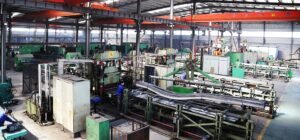
2. Electro‑Forged Welding: Uniting Bars with Heat & Pressure
The core of our process is electro‑forged welding—a method that fuses bearing bars and cross rods using a combination of high electrical current and mechanical pressure. This technique creates a monolithic joint without the need for additional filler material, ensuring consistent weld strength across every panel.
How it works:
Bearing bars are fed into a specialized welding machine in parallel alignment, spaced precisely according to the grating pattern (e.g., 30×100 mm or 40×100 mm).
Twisted cross rods are automatically placed on top of the bearing bars at predetermined intervals.
Under intense pressure and heat (generated by electrical resistance), the cross rods are welded into the bearing bars, forming a solid grid structure.
This fully automated process eliminates human error, guarantees uniform weld penetration, and produces panels that withstand heavy rolling loads and impact—critical for industrial flooring in warehouses, power plants, and offshore platforms.
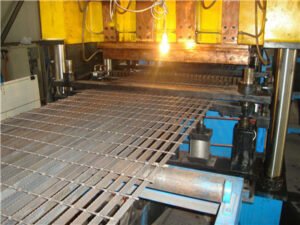
3. Precision Cutting & Edge Reinforcement
Once the large‑format welded panels are formed, they are cut to exact customer specifications using high‑capacity hydraulic shears or precision plasma cutting. For complex shapes (e.g., cutouts for pipes or machinery), we use CNC equipment to maintain accuracy to ±0.5 mm.
To enhance structural integrity and safety, all open ends are reinforced with edge bands—flat steel bars welded along the perimeter. This not only prevents the grating from deforming under load but also provides a finished look and a safer, burr‑free edge for installation.
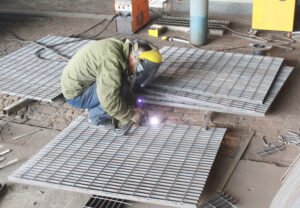
4. Surface Treatment: Built to Withstand Southeast Asia’s Climate
Southeast Asia’s tropical environment—high humidity, frequent rainfall, and coastal salinity—demands exceptional corrosion protection. While painting or powder coating is available, hot‑dip galvanizing remains our standard recommendation.
Our galvanizing process:
Grating panels are thoroughly cleaned (degreased, pickled, and fluxed) to remove any mill scale or contaminants.
They are then immersed in a bath of molten zinc at approximately 450°C.
A metallurgical bond forms, creating a zinc‑iron alloy layer that protects the steel even if the surface is scratched.
Hot‑dip galvanizing provides long‑term corrosion resistance—often exceeding 20 years in industrial environments—making it the preferred choice for projects in Malaysia, Thailand, Vietnam, and the Philippines. For applications requiring additional chemical resistance or color coding, we also offer high‑durability powder coating.
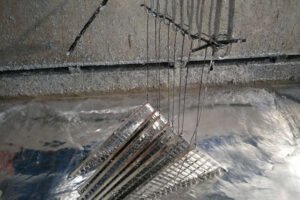
5. Rigorous Quality Inspection
Quality is not an afterthought; it is embedded in every stage. Our finished products undergo a multi‑point inspection process:
Dimensional check: Panel length, width, and bar spacing are verified against engineering drawings.
Weld strength testing: Random samples are subjected to shear and tensile tests to ensure welds exceed industry standards.
Surface finish inspection: We check for galvanizing uniformity, sharp edges, and any visual defects.
Only panels that pass all tests are marked with traceable lot numbers and prepared for export.