Steel Grating Installation Methods
- Welding Installation – Permanent, Strong & Cost-Effective
Welding is the preferred method when grating needs to remain in place permanently without any requirement for future removal. It creates a rigid, load-bearing connection between the grating and its supporting structure.
When to Use Welding
Heavy industrial platforms with constant forklift or vehicle traffic
Permanent mezzanine floors and machine platforms
Outdoor walkways where theft or displacement is a concern
Projects where vibration could loosen mechanical fasteners
Step-by-Step Welding Procedure
Step 1 – Surface Preparation
Before any welding begins, clean the contact areas on both the grating and the supporting steel beams. Remove paint, rust, oil, moisture, and mill scale using a grinder or solvent. Contaminants can cause porosity and weak welds.
Step 2 – Positioning & Tack Welding
Place the grating panel squarely onto the support frame. Apply tack welds at two opposite corners to hold the panel in place. Check alignment with a straightedge.
Step 3 – Final Welding
Weld at all four corners of each panel as a minimum. For heavy-duty applications or areas subject to impact loads, add intermediate welds along the sides (typically every 500-750 mm). Use a sequence pattern (e.g., diagonal corners first) to minimize distortion from heat.
Step 4 – Post-Weld Protection
After cooling, grind any sharp spatter. Immediately apply a zinc-rich cold galvanizing spray or anti-rust paint to the welded joints. In Southeast Asia’s humid climate, this step is essential to prevent accelerated corrosion at the heat-affected zone.
Our recommendation for SEA clients: For outdoor or coastal projects, specify hot-dip galvanized grating combined with zinc-rich touch-up paint on welds. This dual protection can extend service life by years.
- Fastener Fixing – Removable, Reusable & Maintenance-Friendly
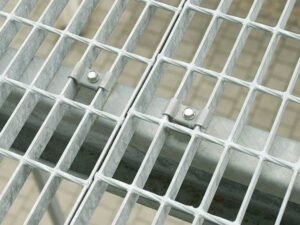
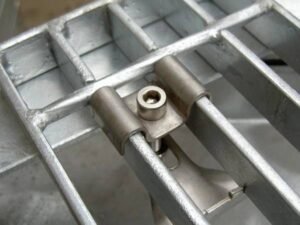
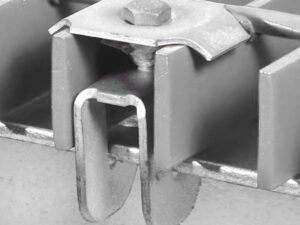
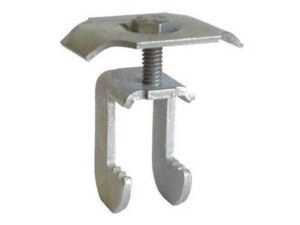
Fastener fixing uses mechanical clips and bolts to secure grating panels without permanent welding. This method is ideal when equipment below the grating requires regular inspection, cleaning, or replacement.
Types of Fasteners Commonly Used
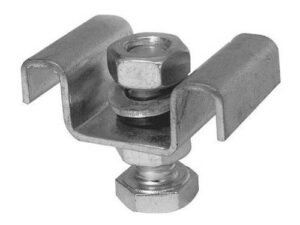
Saddle clips (C-clips) – Wrap around bearing bars and bolt to the support beam.
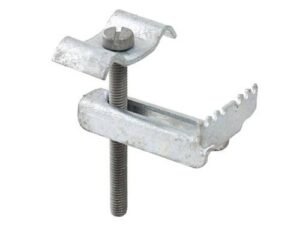
Grate lock fasteners – Spring-loaded or bolt-down clips for quick removal.
G-clips – Provide a low-profile hold, often used for architectural grating.
Recommended Fastener Density
As a general rule, install four fasteners per square meter – one near each corner of the panel. For panels with long unsupported spans (e.g., >1 meter between supports), add one or two extra fasteners along the longer sides to prevent lifting under dynamic loads.
Installation Steps
Step 1 – Position the Upper Clip
Place the upper half of the fastener on top of the grating. Align its saddle so that it straddles two adjacent bearing bars. The clip should sit flush.
Step 2 – Attach the Lower Clip
From underneath the grating, position the lower clip against the bottom face of the supporting steel beam. The saddle of the lower clip must engage the same bearing bars as the upper clip. Ensure the bolt holes of both clips are perfectly aligned.
Step 3 – Secure with Bolts & Nuts
Insert a bolt through the aligned holes (from top to bottom or bottom to top depending on the clip design). Thread the nut and tighten firmly – but avoid over-tightening, which could distort the grating bars. Use a locking washer or thread-locking compound in high vibration environments.
Step 4 – Final Check
Confirm that each fastener is snug and that the panel does not rock or lift when stepped on.
Advantage for Southeast Asian facilities: Fastener fixing allows quick access to drainage channels, pumps, or valves without cutting or re-welding. Many food processing and wastewater treatment plants in Malaysia and Thailand prefer this method for this reason.
- Angle Steel Fixing – A Robust Hybrid Approach
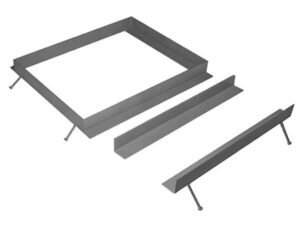
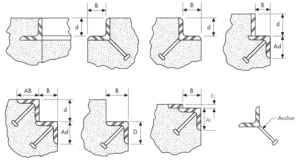
Angle steel fixing involves welding or bolting a continuous angle bar (L-shaped profile) along the edge of the grating panel, then attaching the assembly to the support structure. This method provides edge reinforcement and distributes loads more evenly than point fixings alone.
Typical Applications
Stair treads and landing platforms
Grating panels subject to heavy point loads (e.g., dropped tools or pallets)
Retrofits where the existing support frame is irregular or corroded
Installation Overview
Cut an angle steel section (e.g., 50×50×5 mm) to match the panel’s edge length.
Weld or bolt the angle steel to the underside of the grating’s bearing bars along two opposite edges.
Lower the assembly onto the support beams and weld or bolt the angle steel legs directly to the structure.
This method effectively converts a simply supported panel into a semi-fixed edge-restrained panel, significantly increasing rigidity. It is particularly useful for heavy-duty dock plates or bridge decking.