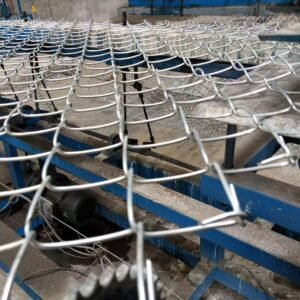
chain link fence is typically manufactured using automated machinery that weaves coiled metal wires into a secure mesh. The process begins with the wires being continuously pre-bent into uniform wave-like patterns. These corrugated wires are then fed into a knitting mechanism, where they are spiral-interlocked with one another. This unique method creates a flexible mesh sheet that is both sturdy and resilient. Finally, the mesh is trimmed to size, rolled into coils, and often receives surface treatments such as galvanizing or PVC coating to enhance durability and corrosion resistance.
2. Production Process: How Chain Link Fencing Is Made
As an experienced manufacturer, we strictly control every step of the production process to ensure consistent quality.
Step 1: Raw Material Selection
We use high-quality low-carbon steel wire or galvanized steel wire. The wire diameter typically ranges from 1.5 mm to 5.0 mm, depending on the application.
Step 2: Galvanization or Coating
To ensure corrosion resistance — especially important in Southeast Asia’s humid climate — we offer:
Hot-dip galvanized: Provides superior rust protection for long-term outdoor use.
PVC coated: Available in various colors (green, black, white) for added aesthetics and corrosion resistance.
Electro-galvanized: Suitable for indoor or temporary applications.
Step3: Weaving
The wire is woven into a diamond mesh pattern using automatic weaving machines. Standard mesh sizes include:
50 mm × 50 mm (2″ × 2″)
60 mm × 60 mm
75 mm × 75 mm
Step 4: Quality Inspection
Every batch undergoes strict quality checks for:
Mesh uniformity
Wire tensile strength
Coating thickness
Zinc coating adherence